
FCC Tightens EMC Rules for LED Displays
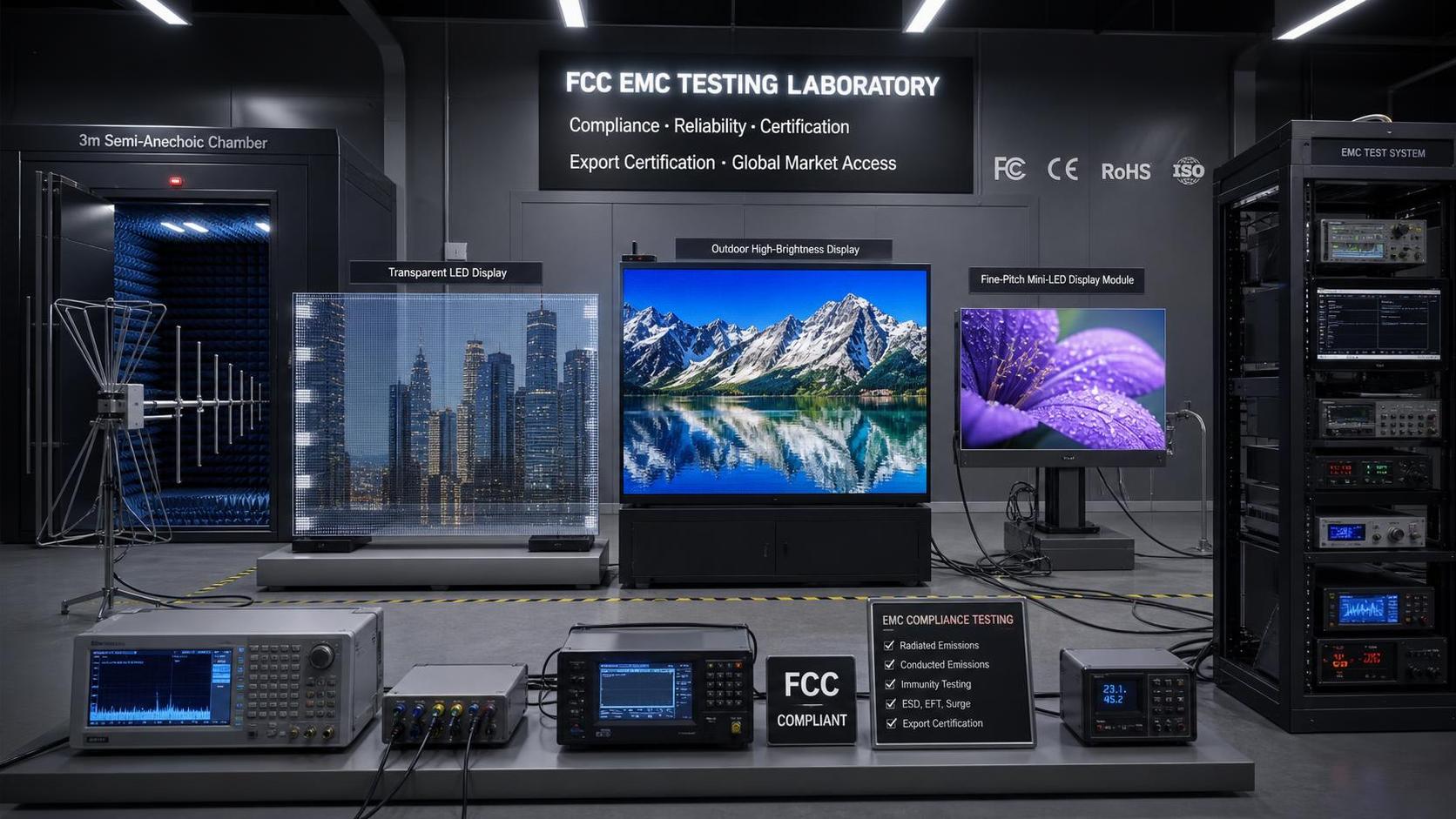
On July 20, 2026, the U.S. Federal Communications Commission released a revised version of FCC KDB 859415 D02 v1.2, updating EMC test requirements for LED display-related products and setting mandatory enforcement from September 2026. For exporters serving the North American market, especially those involved with Transparent LED Screens, outdoor high-bright LCDs, and fine-pitch Mini-LED products, this is not a routine standards update. It directly affects certification workflows, shipment readiness, and customs clearance expectations tied to FCC ID compliance.
What the FCC update formally changes
According to the information provided, the FCC issued the revised FCC KDB 859415 D02 v1.2 on July 20, 2026. The revision adds radiated emission limits and test setup requirements for outdoor high-brightness LED video walls and DOOH digital signage. It also places stronger emphasis on immunity verification in the 1-6 GHz frequency range.
The update has a direct compliance impact on products exported from China to North America, including Transparent LED Screens, Outdoor High-bright LCDs, and Fine-pitch Mini-LED displays. The provided information also states that products without certification under the revised FCC ID requirements will not be able to clear customs.
Where the impact is likely to appear first
Export-facing display suppliers will see compliance risk move forward in the sales cycle
From an industry perspective, companies shipping display products into North America may feel the effect before goods leave the factory. The reason is straightforward: the update changes the certification path itself. The main business impact is likely to show up in model qualification, pre-shipment review, and export documentation checks, with particular attention on whether a product has been assessed under the revised FCC framework.
Manufacturers of targeted product categories face a narrower margin for test readiness
For manufacturers of Transparent LED Screens, outdoor high-bright LCDs, and fine-pitch Mini-LED products, the practical pressure point is likely to be test preparation. Analysis shows that any product category explicitly named in the update should be reviewed against the new radiated emission limits, revised test layouts, and the reinforced 1-6 GHz verification focus. What deserves closer attention is whether current design and validation routines still align with the new certification expectations.
Supply chain and delivery teams may need to watch certification timing more closely
Observably, the issue is not limited to engineering teams. Supply chain coordinators, exporters, and delivery planners may also be affected because customs clearance is tied to certification status under the revised FCC ID requirements. In business terms, the key change may appear in shipment scheduling, document readiness, and communication between factories, testing partners, and overseas customers.
Buyers and channel-side partners may pay closer attention to certification status
For distributors, project buyers, and downstream service providers in the North American market, the main concern is likely to be procurement certainty. If a product has not completed the applicable certification path under the revised rules, that may affect order execution and delivery expectations. From an industry perspective, certification status may become a more immediate screening condition during vendor confirmation and project planning.
What companies should monitor now
Track how the revised requirements are applied in actual certification work
One practical priority is to distinguish the published revision from its implementation in real certification workflows. Companies involved in export, manufacturing, or project delivery should closely follow how the revised FCC KDB 859415 D02 v1.2 is interpreted in testing and filing practice, especially for the product categories specifically referenced in the provided information.
Review whether core product lines fall directly within the affected scope
Another immediate focus is product mapping. Businesses with Transparent LED Screens, outdoor high-bright LCDs, or fine-pitch Mini-LED models aimed at North America should review which SKUs, configurations, or pending shipments are tied to the updated compliance path. Analysis shows that this step matters because the update is not framed as a broad market comment; it is tied to named display categories and certification consequences.
Check document readiness and supplier coordination before shipment milestones
For teams managing cross-border delivery, what deserves closer attention is document completeness and supplier alignment. That includes confirming whether internal teams and external partners are working from the same understanding of the revised FCC ID requirement, and whether supporting certification materials are ready early enough to avoid disruption at later shipping stages.
Prepare customer communication around timing and certification status
For sales and account teams, it is advisable to treat this as a communication issue as well as a compliance issue. Where North American orders are involved, customers may need clearer updates on certification status, expected lead times, and any dependency related to the revised FCC requirements. This is particularly relevant where delivery commitments depend on clearance timing.
Why this reads as more than a routine standards revision
Analysis shows that the significance of this update lies less in headline value and more in where it lands in the transaction process. The revised FCC KDB document links technical test details with market access consequences. That makes it more than a laboratory-side adjustment for the affected display categories.
It is more appropriate to understand this as both a near-term operational change and a longer-term regulatory signal. In the near term, the clear issue is enforcement from September 2026 and the stated customs clearance consequence for products lacking certification under the revised FCC ID path. As a longer-term signal, the update suggests closer scrutiny of EMC validation for certain display formats used in outdoor and digital signage scenarios. Even so, continued observation remains necessary because the provided information does not go beyond the released revision and its direct stated implications.
How the market is likely to read the update for now
At this stage, the most balanced interpretation is that the FCC revision creates an immediate compliance checkpoint for specific display product categories entering North America. It should not be treated as a generic market narrative, but neither is it limited to a narrow paperwork issue. The stronger implication is that certification timing, testing preparation, and shipment planning are now more tightly connected for affected exporters and their partners.
From an industry perspective, the most useful current reading is practical rather than speculative: this is a rule change with direct execution consequences, and the appropriate response is careful verification of scope, certification status, and delivery impact.
Basis of this article and areas to keep verifying
This article is based on the user-provided news title, event date, and event summary concerning the FCC revision to LED display EMC testing requirements. For this type of industry update, commonly relevant source categories may include official regulatory notices, company statements, industry association updates, authoritative media coverage, and standard-related documents.
No specific official source link was provided in the input, so the exact official publication path still requires ongoing verification. Observably, the next areas worth monitoring are any further official wording, certification practice details tied to the revised FCC KDB 859415 D02 v1.2, and any clarifications affecting the named product categories and their export compliance workflow.
Related News